Spanish Income Tax Return 2025: Everything to Check Before 30 June
This article is also available in: Español · Deutsch · Svenska

Note (October 2026): the 2025 income tax campaign closed on 30 June 2026. We are keeping this article for reference; the deadlines and figures it contains refer to that campaign.
The Personal Income Tax (IRPF) campaign starts today, 8 April 2026. This year is expected to be the highest-yielding in history. We explain why, what has changed and how not to pay a euro more than you have to.
Today the 2025 income tax return campaign begins. The deadline for filing the Personal Income Tax (PIT/IRPF) return for the previous tax year ends on 30 June. And this year there are compelling reasons to take it more seriously than ever.
Cumulative inflation over recent years has pushed prices up across the board. In many cases, salaries have not grown in the same proportion. Tax rates, for their part, have not been adjusted. The result is a matter of arithmetic: more taxpayers reach the thresholds that trigger the obligation to file, more income becomes subject to tax and the State collects more, even though the real purchasing power of many households has fallen. Experts agree that the 2025 campaign will be the highest-yielding in history.
More inflation, salaries that are not keeping pace and tax rates that are not adjusted. The result: the 2025 income tax campaign is set to be the highest-yielding in history.
In this scenario, reviewing your return carefully is not an optional formality. It is the only way to pay exactly what is due, no more and no less. This article sets out the key points. For the full technical analysis, including all deductions with their detailed requirements and amounts, you can download the attached guide.
📎 For the full technical analysis of all deductions, reductions, regulatory changes and deadlines, the 2025 Income Tax Campaign Guide prepared by Vicens Advisors is attached.
Vicens_Advisors_Guia_Renta_No expertos conv 1Download
Who Is Required to File a Return?
The obligation to file a return depends on the type of income and its amount. The table below sets out the most common cases:
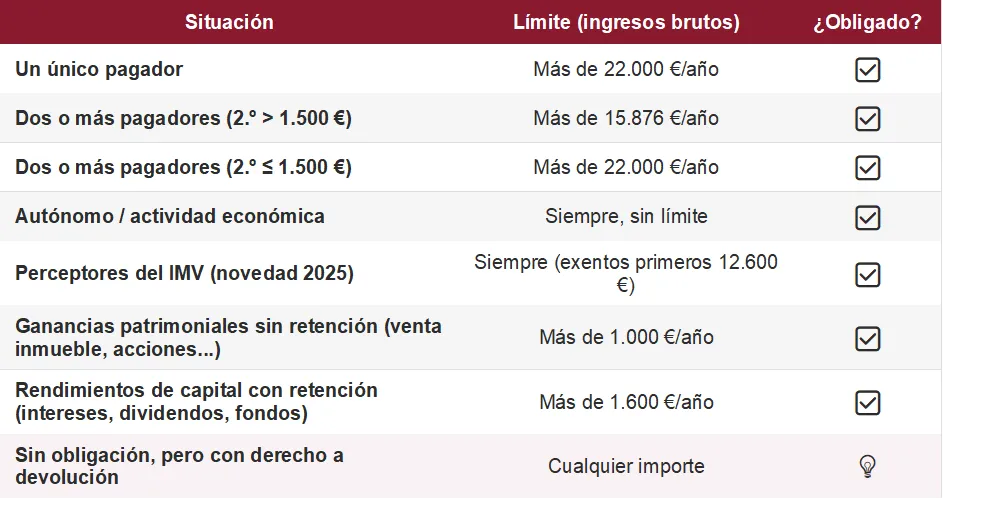
The thresholds are calculated on gross income, before withholdings and social security contributions, not on the net salary actually received. This is the most frequent mistake and can lead to a return not being filed when it is in fact mandatory.
Situations that give rise to the “multiple payers” condition more often than expected: changing employer during the year, receiving unemployment benefit, temporary incapacity benefit paid by the Social Security or by a mutual insurance fund, or working simultaneously in two jobs.
Even where there is no formal obligation to file, it may be advisable to do so if the result is a refund. Deductions that are not applied automatically, such as those for maternity, childcare or energy efficiency, can generate refunds that are lost entirely if no return is filed.
The Most Relevant Changes to IRPF for 2025
New Deduction for Income Close to the Minimum Wage
Law 5/2025 introduces a deduction from the tax liability of up to 340 euros for taxpayers whose net employment income is below 18,276 euros a year, linked to the increase in the national minimum wage (SMI) (16,576 euros in 2025). It is reduced progressively and disappears in the upper band. It does not apply if other income exceeding 6,500 euros is received.
The Maximum Marginal Rate on the Savings Tax Base Rises
Capital income (dividends, interest, capital gains) exceeding 300,000 euros a year is now taxed at 30%, compared with the previous 28%. This affects individuals with high capital income and large-scale divestment transactions.
Energy-Efficiency Deductions for Dwellings Are Extended
The 20%, 40% and 60% deductions for energy-improvement works remain in force for works carried out up to 31 December 2026. The deduction is applied in the tax year in which the energy certificate issued after the works is obtained, not the year in which they are paid for. Works paid for in earlier years may give rise to a deduction in 2025 if the certificate belongs to this tax year.
For residents of the Balearic Islands, these State deductions can be combined with the regional deduction of 50% for sustainability improvements to the main residence.
Recipients of the Minimum Vital Income (IMV): Required to File Since 2025
All members of the household unit who receive the Minimum Vital Income (Ingreso Mínimo Vital, IMV) are required to file a return. The first 12,600 euros of the IMV are exempt, but the obligation to file applies in any event.
Where the Tax Authorities Are Focusing Their Attention
The Spanish Tax Agency (AEAT) has increasingly precise cross-checking systems. These are the points that most frequently give rise to adjustments:
- Confirming the draft return without reviewing it. The draft does not automatically include the regional deductions of the Balearic Islands, family changes during the year, trade union or professional association dues, or income received without withholding. Accepting it as it stands can mean paying too much or too little.
- Undeclared rental income. The tax authorities cross-check data from the land registry (catastro), the regional registers of lease contracts and bank movements. The obligation exists even if the contract is verbal or the amount is small.
- Imputed income on a second home. Any urban property that is not let and is not the main residence requires an imputed income of 1.1% or 2% of its cadastral value to be declared. It is one of the most frequent omissions and one of the easiest to detect.
- Omitted capital gains. The sale of shares, funds, real estate or crypto-assets must be included in the savings tax base. Digital platforms (Wallapop, Vinted, cryptocurrency exchanges) are required to report transactions to the AEAT.
- Failing to apply the exemption for reinvestment in a main residence. The gain arising from the sale of the main residence may be exempt if the proceeds are reinvested in a new dwelling within two years. It must be expressly stated in the return: if it is not, the tax authorities assess the full gain with late-payment interest. The Resolution of the Central Economic-Administrative Tribunal (TEAC) of 31 March 2025 confirms that this is a right of the taxpayer, exercisable even by means of a rectification request within the limitation period.
Regional Deductions in the Balearic Islands: The Most Relevant
Residents of the Balearic Islands have up to 24 deductions available against the regional gross tax liability. None of them appears in the draft return. They must be entered manually and the corresponding requirements must be evidenced. These are the ones with the greatest practical application:
- Rent for the main residence (tenant). 40% of the expenses paid, subject to a limit of 40% of the regional tax liability. Maximum taxable base: 52,800 euros for an individual return.
- Landlord of a permanent residence. 75% of non-payment insurance premiums and 50% of other expenses linked to the lease (IBI property tax, community charges, maintenance). Only for leases of a main residence, not holiday lets.
- Sustainability improvements to the main residence. 50% of investments that evidence an energy improvement, which can be combined with the State deductions of 20%, 40% or 60%.
- Textbooks. 100% of the expense, up to 220 euros per child (350 euros for large families, single-parent families, a child with a disability or a taxpayer under 30).
- Work-life balance with children under 6. 40% of childcare and carer expenses, up to 660 euros per dependent child (50% and 900 euros for large families and single-parent families). Payment must be made by non-cash means.
- Extracurricular language classes. 15% of expenses, with a limit of 110 euros per child, for children from nursery school through to upper secondary school (bachillerato) or vocational training (FP). Taxable base limit: 33,000 euros for an individual return.
- Birth or adoption. From 800 to 1,400 euros depending on the order of the child, with the possibility of requesting an advance payment.
- Disability. From 88 to 165 euros for each member of the family unit with a recognised disability, depending on the degree and type.
- Higher education outside the island of residence. 1,800 euros per dependent child studying at university or in higher vocational training (FP superior) on a different island.
- Investment in newly created companies. 30% of the amount invested in incorporation or capital increases, with a maximum base of 6,000 euros a year.
- Self-employment. 1,000 euros for those who register for the first time in the census of entrepreneurs, with the activity carried out mainly in the Balearic Islands.
State Deductions Not to Be Overlooked
Several State deductions are likewise not included automatically in the draft return and require active completion:
- Maternity and childcare. Up to 1,200 euros a year per child under three for working mothers, plus up to 1,000 euros additional for nursery or early-childhood education centre expenses. It does not appear in the draft if no advance payments were requested.
- Pension plans. Contributions directly reduce the general taxable base. Limit of 1,500 euros a year, which can be increased to 10,000 euros if there are employer contributions to occupational pension plans.
- Irregular income. Income generated over more than two years (severance payments, collective-agreement arrears, multi-year bonuses) is entitled to a 30% reduction, with a maximum base of 300,000 euros. The payer often does not apply it in the withholding; it can be claimed in the return.
- Donations. 80% of the first 250 euros and 40% of the remainder, for donations to entities covered by Act 49/2002 (tax regime for non-profit entities and patronage incentives). They require a certificate from the recipient entity.
- Trade union and professional association dues. These are deductible expenses against employment income that reduce the taxable base. They do not appear in the draft and must be entered manually.
Individual or Joint Filing: The Most Underestimated Choice
Joint filing allows an additional reduction of 3,400 euros on the taxable base for married couples (2,150 euros for single-parent families). The practical rule: if one spouse does not work or has income below that figure, joint filing almost always proves more advantageous. If both have significant income, the progressive tax scale penalises the combined total and individual filing is usually the more efficient option.
The choice can be changed by filing a new return before 30 June. After the deadline, the option is irrevocable. Renta Web (the AEAT’s online filing platform) allows both options to be compared before confirming.
Key Dates of the Campaign
- 8 April. Start of the campaign. Access to the draft return on Renta Web.
- 25 June. Last day to set up direct debit payment for returns with an amount payable.
- 30 June. Deadline for filing the return by any method.
- 5 November. Second instalment of the staggered payment (remaining 40%), without interest or surcharges.
Do You Have Questions About Your Return?
The Vicens Advisors team is available for any query about the 2025 income tax campaign and to handle your return, applying every deduction to which you are entitled.
📞 +34 669 684 686 · +34 650 43 48 48
✉️ toni@vicensadvisors.com · virginia@vicensadvisors.com
🌐 www.vicensadvisors.com — appointment calendar available on the website
This article is for information purposes only and does not constitute individual legal or tax advice. For any specific query, we recommend that you contact a qualified tax adviser.
© Vicens Advisors, S.L. All rights reserved.
Reproduction of this content, in whole or in part, by any means or procedure, is prohibited without the express written authorisation of its owner. Any unauthorised use will constitute an infringement of intellectual property rights under the legislation in force.