Reform of the Inheritance and Gift Tax in the Balearic Islands: A New Landscape for Family Tax Planning
This article is also available in: Español · Deutsch · Svenska
Introduction
On 25 July 2025 a major tax reform came into force that directly affects inheritances and gifts in the Balearic Islands, approved by means of Law 6/2025 on the General Budget of the Autonomous Region (Ley 6/2025, de Presupuestos Generales de la Comunidad Autónoma). The reform substantially amends the regional regime of the Inheritance and Gift Tax (ISD), building on the measures begun by Decree-Law 4/2023 of 18 July (Decreto-ley 4/2023). With these new rules, the Balearic Islands rank among the autonomous regions with the most favourable framework for the tax optimisation of transfers of wealth between family members, extending the existing rebates and, in some cases, such as gifts between parents and children, granting a 100% rebate on the Inheritance and Gift Tax.
This is a very significant change, which places the Balearic Islands at the forefront in the tax treatment of transfers between family members. However, the regional rebate in the Inheritance and Gift Tax should not be mistaken for a full tax exemption or for no taxation at all: as we shall see below, certain transactions, especially gifts of real estate, may generate significant costs under other taxes, such as the donor’s Personal Income Tax (IRPF), which calls for an overall assessment of the total tax burden. In addition, as already seen with Decree-Law 4/2023, valuation rules are also established that affect real estate.
Even so, this is a far-reaching measure, which completely redefines the strategy for transferring family wealth and opens up opportunities that until now were not available in our region.
The changes concerning gifts and inheritances are analysed separately below, together with some key practical issues: loan waivers and the Personal Income Tax (IRPF) treatment of the donor.
- Changes concerning gifts inter vivos
Until the entry into force of Law 6/2025, the budget law for the 2025 financial year, gifts between individuals in the Balearic Islands were subject to an effective rate of 7% under this tax in the most common cases, such as transfers between parents and children or between grandparents and grandchildren. Unlike the treatment of inheritances, gifts had not been significantly improved by the earlier Decree-Law 4/2023, except in aspects such as the gift of the main residence.
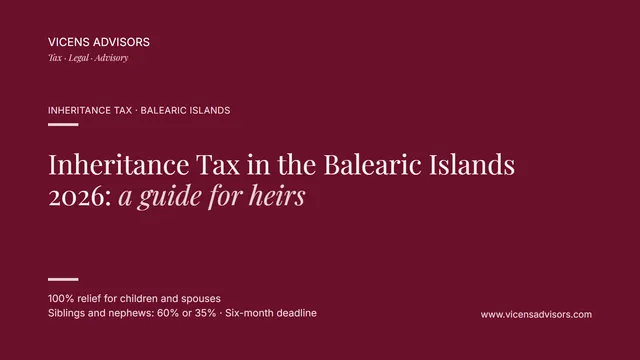
With the reform introduced by Law 6/2025, the Balearic Islands strengthen and extend, very advantageously, their regional regime of deductions for gifts, placing themselves at the forefront of the autonomous regions in terms of tax incentives for inter vivos transfers between family members. The deduction reaches 100% for direct relatives included in groups I (descendants under 21 years of age) and II (descendants aged 21 or over, ascendants and spouses), and a deduction of 60% or 35% is established for the collateral relatives of group III (siblings, uncles and aunts, nephews and nieces), depending on whether or not there are descendants of the donor.
In the case of gifts of real estate, the value stated in the deed must not exceed the reference value (valor de referencia) increased by 20% (or, failing that, the market value), just as happens with inheritances and succession agreements (pactos sucesorios) under Law 11/2023 of 23 November, with effect from 18 July 2023. As we shall see below, this limit may have a direct impact on the determination of the capital gain in the donor’s Personal Income Tax (IRPF).
For the deduction to apply to gifts consisting of cash or bank transfers, it will be essential to document the origin of the funds and to record this circumstance expressly in the public deed of gift.
One of the great advantages of the new gift regime over succession agreements is that it does not require the donee to waive the forced heirship share (legítima) in a future inheritance on death, which gives both parties greater legal flexibility and protection in wealth planning.
In addition, the other existing regional tax incentives for gifts, such as those applicable to the transfer of the main residence, the family business, disability, the acquisition of real estate by young people or persons with disabilities, etc., remain intact and continue to coexist with this new general regime.
- Changes concerning inheritances (mortis causa)
As regards inheritances, the changes introduced by Law 6/2025 are not as significant for direct heirs, because, since the earlier reform, a 100% rebate has already applied to the corrected full tax liability (cuota íntegra corregida) on acquisitions by reason of death, and, by assimilation, on the succession agreements regulated in Law 8/2022, in favour of taxpayers included in groups I and II.
The real novelty lies in the introduction of new rebates for the collateral relatives of group III. From 25 July 2025, a rebate of 60% (previously 50%) applies to siblings, uncles and aunts, or nephews and nieces of the deceased who do not concur with descendants or adopted children of the deceased, or who concur with disinherited descendants. For all other persons in group III, the rebate will be 35% (previously 25%).
As with gifts, if real estate is acquired, its value must be stated in the public deed, and it may not exceed the reference value increased by 20% or, failing that, the market value determined in accordance with the applicable cadastral criteria. This limit has applied to inheritances since Law 11/2023 (with effect from 18 July 2023), but it is new in the case of gifts. In addition, Law 6/2025 removed the requirement to be subject to unlimited tax liability, so non-residents who opt for the Balearic rules can also apply these rebates. We explain this, with examples for 2026, in our guide to Inheritance Tax in the Balearic Islands 2026.
- Gifts of real estate: capital gain in the donor’s Personal Income Tax (IRPF)
Although the new rebates in the Inheritance and Gift Tax may mean that the recipient of a gift does not have to pay anything by way of Inheritance and Gift Tax, this does not mean that the transaction as a whole is free of tax. When the subject of the gift is real estate, the donor must pay tax on the capital gain generated, in accordance with the rules of Personal Income Tax (IRPF).
For IRPF purposes, the gift of a property is regarded as a transfer for no consideration, and may therefore generate a capital gain (or loss) for the person making the gift. That gain is calculated as the difference between the value assigned to the property in the deed of gift (transfer value), which must be at least the reference value, and the donor’s original acquisition value.
The gain obtained is included in the savings income base of the IRPF and is taxed at the rates in force depending on the amount. In many cases, the tax saving obtained by the donee in the Inheritance and Gift Tax is completely cancelled out by the donor’s IRPF liability, especially where the property has appreciated considerably. Unlike inheritances and succession agreements, in which no capital gain arises (because the so-called “plusvalía del muerto”, the tax on the gain at death, was abolished years ago), gifts are subject to IRPF. This difference may have a significant impact on family tax planning. But for these cases the Balearic Islands have the advantage of the succession agreement (pacto sucesorio), which makes it possible to bring forward the succession without generating a capital gain in the IRPF for the transferor, thus avoiding the tax impact that may arise on gifts of real estate.
It is also worth comparing this situation with gifts of money, where, if the origin of the funds is documented and the gift is properly formalised in a public deed, taxation may effectively be nil, both in the Inheritance and Gift Tax and in the IRPF, where no impact arises.
Moreover, as also happens with inheritances and succession agreements, it is crucial to plan in advance what will become of the donated property, since a subsequent sale could also generate a liability in the donee’s IRPF. In this context, it is advisable to adopt a global, integrated view of the family’s wealth before taking decisions on early transfers. At Vicens Advisors we are experts in comprehensive tax and wealth planning, and we can help you identify the most efficient alternative for each specific case.
- Waiver of earlier loans: tax warnings
Before the reform, many taxpayers avoided formalising gifts because of the effective tax rate of 7%, opting instead for loans between private individuals, usually between parents and children, at zero interest and with maturities many years ahead. In the current context, with deductions that in certain cases allow reduced or nil taxation in the ISD, this strategy would no longer be necessary if what was really intended was to transfer funds.
Nevertheless, it should be noted that if a taxpayer now decides to formally waive a loan on which no part of the principal has been repaid, the Administration is likely to consider that the animus donandi (intention to make a gift) existed from the outset, that is, from the moment the funds were handed over, which will be before the entry into force of the new law.
In that case, the taxable event of the gift would be taken back to the date of the loan, which would mean not only losing the right to the deduction, but also a reassessment of the transaction at the rate of 7%.
For a gift to be valid from a legal and tax point of view, the following requirements must be met, as recognised by the Directorate-General for Taxes (DGT) in Binding Ruling V5410-16:
- An act of disposal by the donor free of charge, with intention to confer a benefit (animus donandi), in favour of the donee.
- Express acceptance of the gift by the donee.
- The donor’s knowledge of the donee’s acceptance.
At Vicens Advisors we have a team specialised in analysing each wealth situation individually and offering the most suitable tax solution for each case.
Finally, it should be noted that, in addition to these measures, Law 6/2025 has approved new tax rebates applicable to agricultural holdings in respect of the Inheritance and Gift Tax, which will be analysed in a specific article on this blog.
Related articles
© Vicens Advisors, S.L. All rights reserved.
Reproduction of this content, in whole or in part, by any means or procedure, is prohibited without the express written authorisation of its owner. Any unauthorised use will constitute an infringement of intellectual property rights under the legislation in force.