Inheritance Tax in Mallorca and the Balearic Islands 2026: a complete guide for heirs
This article is also available in: Español · Deutsch · Svenska
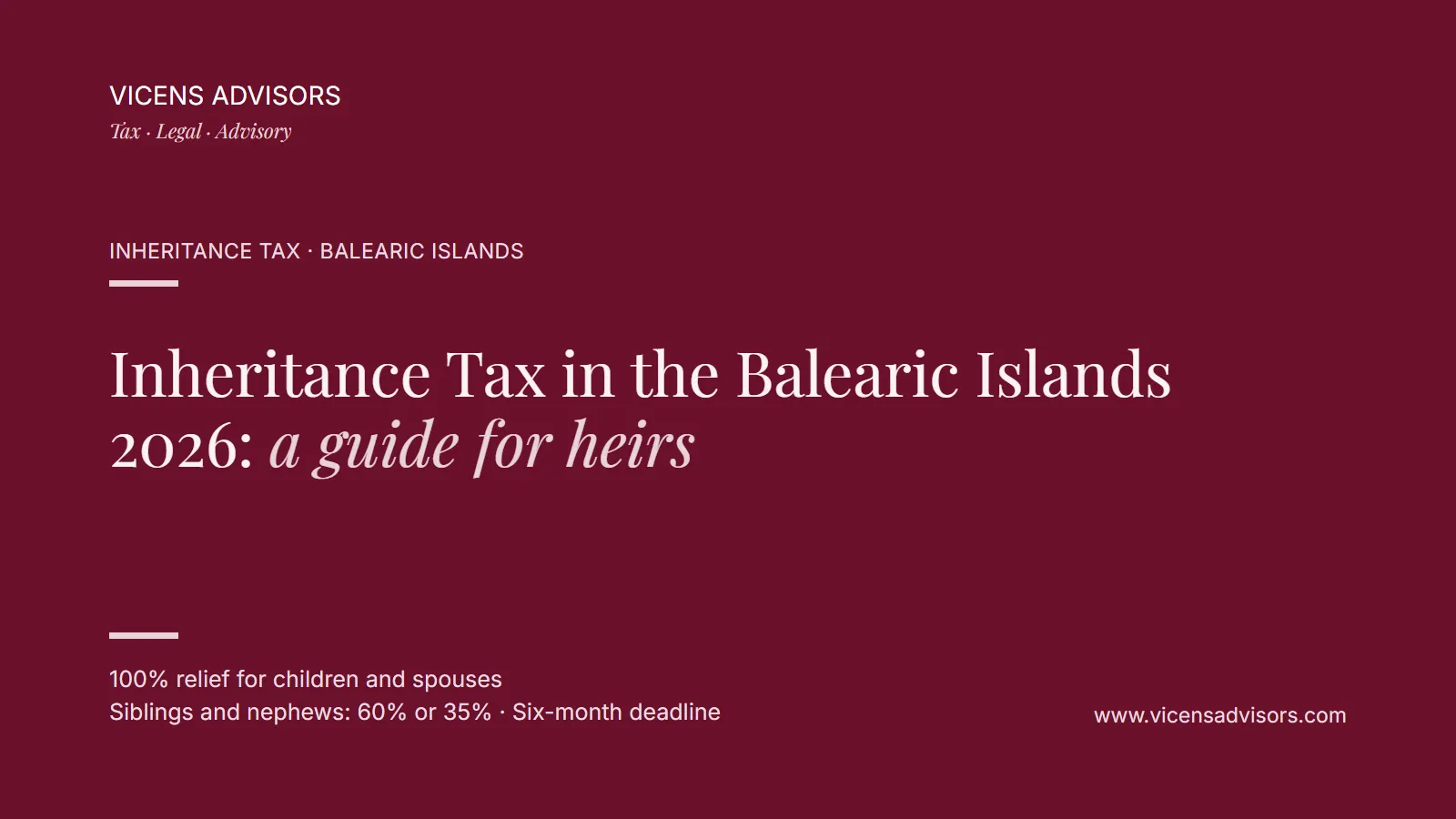
This guide explains how an inheritance is taxed in the Balearic Islands (Illes Balears) when the death occurs in 2026: who pays, which reductions and reliefs apply, how the tax is calculated, which deadlines must be met and what happens if the deceased or the heir is not resident in Spain. It includes examples with figures. It has been reviewed against the legislation in force as at 5 November 2026.
In brief
- Children, grandchildren, spouses and parents (groups I and II) have a 100% relief (bonificación) on the tax liability (cuota): in practice, they pay no Inheritance Tax. Registered stable partners (parejas estables) receive the same treatment as spouses.
- Siblings, nephews and nieces, and uncles and aunts by blood have a 60% relief if the deceased leaves no children (or leaves only disinherited children). If there are children, or if the relationship is by marriage (brothers- and sisters-in-law, parents-in-law, sons- and daughters-in-law), the relief is 35%.
- Cousins and unrelated persons (group IV) have no regional relief.
- Even if there is nothing to pay, the self-assessment must be filed (form 650, modelo 650) within 6 months of the death.
- To apply the reliefs, the value of the properties stated in the deed may not exceed the cadastral reference value (valor de referencia) increased by 20%.
- Non-residents can also apply the Balearic rules and their reliefs, filing the tax with the Spanish Tax Agency (Agencia Tributaria).
Which rules apply
Inheritance Tax is a State tax (Law 29/1987 and its Regulations, Royal Decree 1629/1991) ceded to the autonomous regions, which may regulate the reductions, the rate scale, the coefficients and the reliefs. The Balearic rules are in Legislative Decree 1/2014 (Decreto Legislativo 1/2014), the consolidated text on ceded taxes, as subsequently amended.
For deaths in 2026, the reliefs set by Law 6/2025, the budget law for 2025, in force since 25 July 2025, apply. The Balearic Islands have not approved a budget for 2026 (the 2025 budget has been extended) and, as at the date of this guide, there is no record of any subsequent amendment to the inheritance tax rules. Royal Decree-law 29/2026 does not amend this tax, although it does amend the municipal capital gains tax (plusvalía municipal) (see below).
When do the Balearic rules apply? When the deceased had their habitual residence in the Balearic Islands, that is, when in the five years before the death they spent more days in the Balearic Islands than in any other region, and the heir is resident in Spain (Articles 28 and 32 of Law 22/2009). In that case the tax is filed with the Balearic Tax Agency (Agència Tributària de les Illes Balears, ATIB). If the deceased or the heir is not resident in Spain, see the section on non-residents.
Step 1. The kinship group and the kinship reduction
Kinship with the deceased determines the reduction in the taxable base, the rate scale, the coefficient and the relief (Article 21 of Legislative Decree 1/2014):
| Group | Who | Kinship reduction |
|---|---|---|
| I | Descendants under 21 | €25,000 + €6,250 for each year under 21, up to a maximum of €50,000 |
| II | Descendants aged 21 or over, spouse and ascendants | €25,000 |
| III | Siblings, nephews and nieces, and uncles and aunts (2nd- and 3rd-degree collateral relatives), and ascendants and descendants by marriage (parents-in-law, sons- and daughters-in-law, stepchildren) | €8,000 |
| IV | Cousins, more distant relatives and unrelated persons | €1,000 |
Stable partners (parejas estables) receive the same treatment as spouses if they meet the requirements of Law 18/2001 on stable partnerships of the Balearic Islands, including registration in the register of stable partnerships or in a similar public register of another State (Article 60.1 of Legislative Decree 1/2014). Unregistered couples do not receive that treatment.
Step 2. Other reductions of the taxable base
In addition to the kinship reduction, the Balearic rules provide for the following reductions, among others (Articles 22 to 32 bis of Legislative Decree 1/2014):
- Disability: €48,000 for a degree of disability of 33% or more but below 65%, and €300,000 for a degree of 65% or more (or a mental disability of 33% or more).
- Main residence of the deceased (vivienda habitual): 100% of its value, up to a limit of €270,151.20 per heir, for the spouse, ascendants, descendants and collateral relatives over 65 who lived with the deceased during the two previous years. The residence must be kept for 5 years; if it is sold earlier, the position must be regularised with late-payment interest. Law 4/2026, in force since 14 June 2026, and Order 13/2026 allow that limit to be raised depending on the island (€331,859.70 in Mallorca and Menorca; €378,211.68 in Ibiza and Formentera). Their specific application to inheritances is pending a criterion from the ATIB, so it should be reviewed case by case.
- Family business and shareholdings: 95% of the value of the business, the professional business or the shareholdings that are exempt from Wealth Tax, for the spouse and descendants (and, if there are no descendants, ascendants and collateral relatives up to the third degree). The acquisition must be kept for 5 years (the State rules require 10). We discuss this in the 95% reduction and the employee requirement in letting activities.
- Farms located in the Balearic Islands: 100%, subject to requirements on use in the farming activity, retention for 5 years and agricultural income (see our analysis of Law 6/2025 for farms).
- Life insurance: 100% up to a limit of €12,000 if the beneficiary is the spouse, an ascendant or a descendant.
- Other cases: historic heritage assets (95% or 99%), zero-emission vehicles (50%) or ECO vehicles (25%), money used to set up a business, and successive transfers of the same assets within less than 12 years.
With the 100% relief, in groups I and II these reductions rarely change the final result, but they remain important in two situations: if the relief is lost because a requirement is not met, and in inheritances by siblings, nephews and nieces, and uncles and aunts.
Step 3. The rate scale and the pre-existing wealth coefficient
The taxable base (base liquidable: the net value inherited less the reductions) is subject to a different rate scale depending on the group (Article 33):
- Groups I and II: 1% up to €700,000; 8% from €700,000 to €1,000,000; 11% from €1,000,000 to €2,000,000; 15% from €2,000,000 to €3,000,000, and 20% above €3,000,000.
- Groups III and IV: progressive scale from 7.65% to 34%.
| Taxable base from | Full tax liability (cuota íntegra) | Remaining base up to | Rate |
|---|---|---|---|
| €0 | €0 | €8,000 | 7.65% |
| €40,000 | €3,740 | €8,000 | 11.90% |
| €80,000 | €9,180 | €40,000 | 16.15% |
| €120,000 | €15,640 | €40,000 | 18.70% |
| €160,000 | €23,120 | €80,000 | 21.25% |
| €240,000 | €40,120 | €160,000 | 25.50% |
| €400,000 | €80,920 | €400,000 | 29.75% |
| €800,000 | €199,920 | onwards | 34.00% |
Abridged table. Between €0 and €80,000 there are bands of €8,000 with rates from 7.65% to 15.30%.
The resulting tax is multiplied by a coefficient that depends on the wealth the heir already had and on their group (Article 34). For groups I and II it ranges from 1 to 1.2; for siblings, nephews and nieces, and uncles and aunts by blood, from 1.2706 to 1.5247; for relatives by marriage in group III, from 1.6575 to 1.9550, and for group IV, from 1.7 to 2.04.
Step 4. The 2026 reliefs
The regional reliefs are applied to that adjusted tax liability (Articles 36 and 36 bis of Legislative Decree 1/2014, as worded by Law 6/2025):
| Heir | Relief |
|---|---|
| Groups I and II: descendants, spouse, ascendants and registered stable partners | 100% |
| Siblings, nephews and nieces, and uncles and aunts (blood relatives) where the deceased leaves no descendants, or leaves only disinherited descendants | 60% |
| Rest of group III: the same collateral relatives where there are descendants, and relatives by marriage (brothers- and sisters-in-law, nephews and nieces by marriage, parents-in-law, sons- and daughters-in-law, stepchildren) | 35% |
| Group IV | No relief |
The reliefs also apply to the succession agreements (pactos sucesorios) of Balearic civil law (donación universal, definición, finiquito), which are taxed under this tax. We explain this in the definició between spouses and in donations from parents to children in the Balearic Islands.
Two requirements not to be overlooked:
- Value of the properties. If properties are inherited, the value stated in the deed may not exceed the cadastral reference value increased by 20% (or the market value, if there is no reference value). The rules frame this as a requirement for applying the relief, so the value should be set carefully in the deed of acceptance of the inheritance. It also has consequences for Personal Income Tax (IRPF) when the heir sells the property.
- Filing the self-assessment. The relief does not exempt the heir from filing the tax return. Even if the tax due is zero, it must be filed on time.
Examples
All three examples assume a death in October 2026, with the deceased resident in the Balearic Islands and heirs resident in Spain.
Example 1. A 40-year-old son inherits €400,000, of which €250,000 corresponds to his father’s main residence.
- Kinship reduction (group II): €25,000. Main residence reduction: €250,000.
- Taxable base: 400,000 − 25,000 − 250,000 = €125,000. Tax (1%): €1,250. Coefficient: 1.
- 100% relief: tax payable, €0. He must file form 650 within 6 months and keep the residence for 5 years so as not to lose the reduction.
Example 2. A nephew inherits €200,000 from an uncle with no children. His pre-existing wealth is €100,000.
- Kinship reduction (group III): €8,000. Taxable base: €192,000.
- Full tax liability: 23,120 + (192,000 − 160,000) × 21.25% = €29,920. Coefficient 1.2706: €38,016.35.
- 60% relief: −€22,809.81. Tax payable: €15,206.54, around 7.6% of the amount inherited.
Example 3. A brother receives a legacy of €50,000 and the deceased leaves children as heirs. The brother’s pre-existing wealth is €500,000.
- Taxable base: 50,000 − 8,000 = €42,000. Full tax liability: 3,740 + 2,000 × 11.90% = €3,978.
- Coefficient 1.3341 (pre-existing wealth between €400,000 and €2,000,000): €5,307.05.
- 35% relief (he inherits alongside descendants): −€1,857.47. Tax payable: €3,449.58.
Deadlines, filing and payment
- Deadline: 6 months from the death (Article 90 of Legislative Decree 1/2014 and Article 67 of the Regulations).
- Extension: a further 6-month extension can be requested within the first 5 months, providing the death certificate, the heirs and an approximate list of the assets. The extension accrues late-payment interest (Article 68 of the Regulations).
- Form: self-assessment on form 650 (modelo 650), one per heir, filed with the ATIB, which allows electronic payment and filing through its electronic office. For groups I and II it is sufficient to provide the will or the declaration of heirs (Article 88.2).
- Deferral and payment in instalments: if there is not enough cash in the estate, deferral or payment in instalments may be requested; for the family business and the main residence there is a special regime of up to 5 years without interest (Articles 38 and 39 of Law 29/1987).
- Late filing: if tax is payable, a surcharge of 1% plus 1% for each full month of delay applies, and of 15% plus interest after 12 months (Article 27 of the General Tax Act). If the tax due is zero because of the relief, late filing may give rise to a penalty for a formal infringement.
Non-resident heirs and deceased persons
If the deceased or the heir is not resident in Spain, the tax is filed with the Spanish Tax Agency (Agencia Tributaria) (form 650), not with the ATIB, and the heir may choose between the State rules and the regional rules (second additional provision of Law 29/1987 and the Spanish Tax Agency’s table of competences):
- Deceased resident in the Balearic Islands and non-resident heir: the Balearic rules may be applied.
- Non-resident deceased: the rules of the region where the greatest value of the assets located in Spain is found may be applied; if there are no assets in Spain, those of the region where the heir resides.
Since 2021 this right is not limited to residents of the EU or the European Economic Area: it also extends to those resident, for example, in the United Kingdom, Switzerland or the United States. And since 25 July 2025 the Balearic reliefs no longer require “unlimited tax liability” (obligación personal de contribuir), so a non-resident child who opts for the Balearic rules can apply the 100% relief. Non-residents are taxed only on assets located in Spain. We expand on this in wealth planning in Mallorca for residents and non-residents and on our page on tax advice for non-residents.
Other taxes on an inheritance
- Municipal capital gains tax (plusvalía municipal): paid by the heir on urban properties. It must be declared within 6 months, extendable to one year, and many town councils grant a relief of up to 95% on inheritances between close family members, depending on their bylaws. Royal Decree-law 29/2026 updates the maximum coefficients from 1 December 2026, although as at the date of this guide there is no record of its validation.
- IRPF: inheriting does not generate a capital gain for the deceased or income for the heir, but the value declared in the inheritance will be the acquisition value when the heir sells.
- Wealth Tax: what is inherited is added to the heir’s wealth at 31 December. In the Balearic Islands the tax-free allowance is €3,000,000.
- Charges on properties: before selling or buying an inherited property it is advisable to check that the tax was paid; we explain this in buying a property with Inheritance Tax debts.
Frequently asked questions
Do I have to pay Inheritance Tax in the Balearic Islands if I inherit from my parents?
In the vast majority of cases, no: children and spouses have a 100% relief. But form 650 must be filed within 6 months and the requirements must be met, in particular the one concerning the value of the properties in the deed.
How much does a nephew or a sibling pay?
It depends on the amount, their pre-existing wealth and whether the deceased leaves children. With €200,000 inherited and no children of the deceased, around €15,200 (60% relief). If there are children, the relief falls to 35%.
What happens if I do not file the tax on time?
Surcharges apply to the amount payable (from 1% to 15% plus interest, depending on the delay). If there is nothing to pay, there may be a penalty for a formal infringement. If you expect not to meet the deadline, the prudent course is to request the extension within the first 5 months.
I live outside Spain and I am inheriting from a parent resident in Mallorca. Which rules apply to me?
You can choose the Balearic rules and apply the 100% relief. The tax is filed with the Spanish Tax Agency, not with the ATIB.
Do unmarried couples (parejas de hecho) have the same relief?
Only stable partners registered in the register of stable partnerships of the Balearic Islands or in a similar register. Unregistered couples are taxed as unrelated persons (group IV).
How we work at Vicens Advisors
In an inheritance we review Inheritance Tax, the municipal capital gains tax and the future consequences for IRPF and Wealth Tax together, set the value of the properties in the deed, prepare and file the self-assessments and, where non-residents are involved, choose the most favourable rules before the Spanish Tax Agency. Vicens Advisors, tax advisers in Manacor and Mallorca, is available to heirs who need help with an inheritance in the Balearic Islands.
Sources
- Law 29/1987 on Inheritance and Gift Tax (Articles 7, 24, 31, 38, 39 and second additional provision) and Royal Decree 1629/1991, Regulations of the tax (Articles 67 to 69).
- Legislative Decree 1/2014, consolidated text on ceded taxes of the Balearic Islands (Articles 20 to 36 bis, 60, 86 to 92 and third to fifth additional provisions).
- Law 6/2025 of 23 July on the general budget of the Autonomous Region of the Balearic Islands for 2025; Law 11/2023 of 23 November; Decree-law 4/2023 of 18 July.
- Law 4/2026 of 11 June, and Order 13/2026 of 22 June of the Regional Ministry of Economy, Finance and Innovation (Consejería de Economía, Hacienda e Innovación).
- Law 22/2009 on the financing of the autonomous regions (Articles 28 and 32); Law 58/2003, General Tax Act (Articles 27 and 198).
- Spanish Tax Agency: table delimiting competences for form 650 (updated on 9 June 2026).
- Royal Decree-law 29/2026 of 6 October.
LEGAL NOTICE
This content is for information purposes only and does not constitute tax or legal advice. It is based on the legislation in force and the information available as at 5 November 2026. The figures in the examples are indicative and are based on simplified assumptions. Each inheritance requires a specific analysis. This English version is a translation prepared for information purposes; the Spanish text of the legislation cited is the only authentic version.
© Vicens Advisors, S.L. All rights reserved. Reproduction of this content, in whole or in part, by any means or procedure, is prohibited without the express written authorisation of its owner.